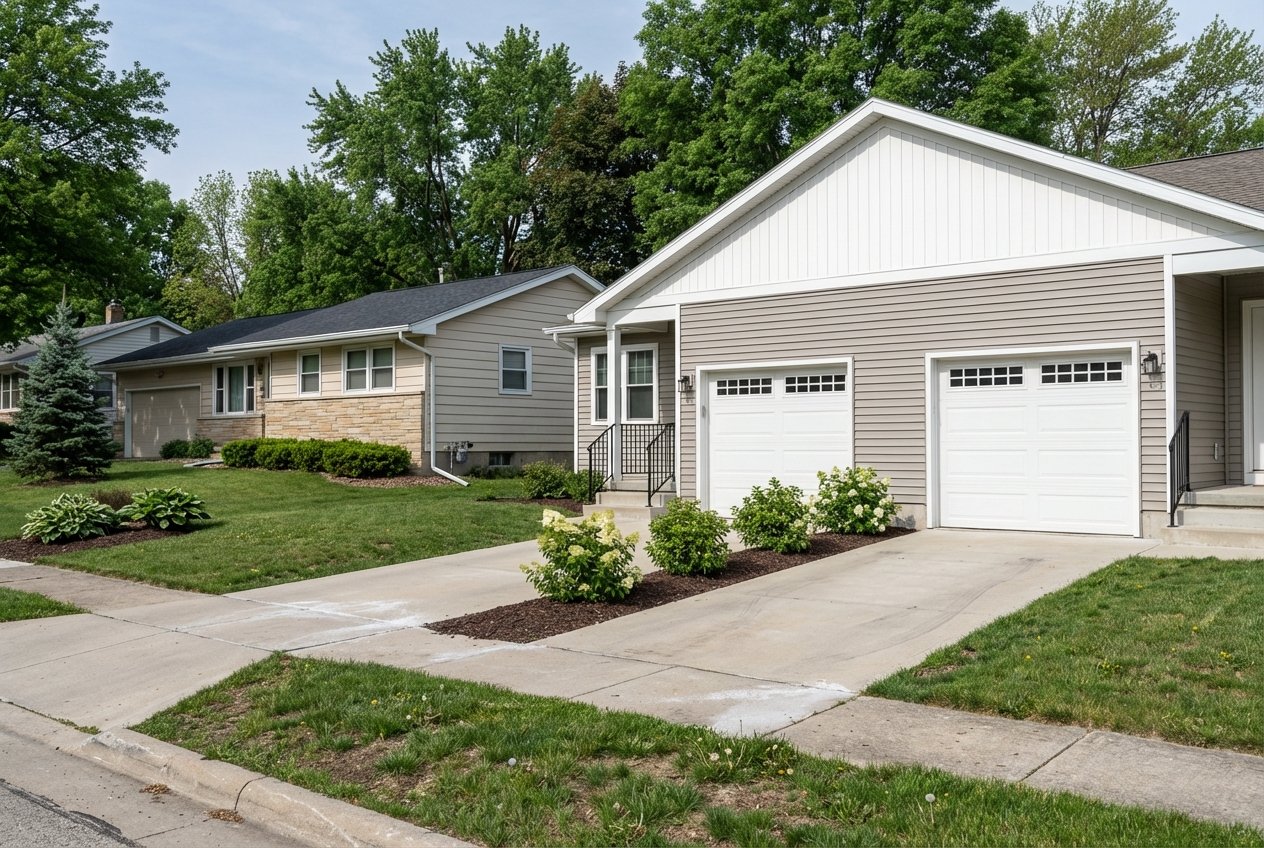
Choosing between a single-family house and a twin home in Holmen can feel tricky. You want the right mix of space, privacy, price, and long-term value. The good news: once you understand how twin homes are owned, financed, and maintained, the decision becomes much clearer. In this guide, you’ll learn what a twin home really is, how it compares to a detached house in Holmen, what to check during due diligence, and how each option affects resale and lifestyle. Let’s dive in.
Quick definitions
Understanding the terms helps you compare apples to apples.
What is a twin home?
A twin home is two side-by-side residences that share one common wall, but each half typically sits on its own parcel and is separately deeded. In many developments, the lot line runs down the center of the shared wall. That means each owner usually has a separate tax bill and can finance their home like a single-family property. Always confirm how the property is platted and recorded before you write an offer. You can also review how attached units are defined in many markets by checking a consumer explainer on duplexes and legal structures from a national source like Bankrate or consulting local code glossaries like the City of Lake Mills zoning definitions for “zero-lot-line” examples.
Twin vs duplex vs townhouse
- Duplex: two units on one legal parcel, often one owner, and typically treated as multifamily for taxes and lending. A twin is different because each half is usually its own lot.
- Twin home: two attached single-family dwellings on separate parcels that share a party wall. Financing and insurance often mirror single-family rules due to separate ownership.
- Townhouse: three or more attached units, commonly governed by a master HOA and CC&Rs that spell out shared maintenance.
Holmen market snapshot
Holmen’s overall home values commonly cluster around the high $300ks to low $400ks. Recent aggregator data shows a median in about the $400k range as of early 2026, with month-to-month movement. Twin homes in Holmen often list from the low $300ks into the mid $500ks depending on size, finishes, and lot. These figures change, so use current MLS comps for precise expectations.
What twin homes look like in Holmen
Many Holmen twin homes are newer ranch or single-level plans with finished basements, main-floor primary suites, open kitchens, main-level laundry, and attached 2-car garages. Builders frequently highlight zero-step entries and low-maintenance exteriors like composite decking and fiber-cement siding. Lots tend to be modest to medium in size, which helps reduce exterior upkeep.
Typical twin home pricing in Holmen
- Common range: roughly low $300ks to mid $500ks based on size, upgrades, and location within the subdivision.
- Overlap with detached homes: pricing often overlaps with single-family listings, though twin homes may offer newer finishes at a slightly lower price or with a smaller lot.
- Subdivision variation: certain neighborhoods with higher-end finishes or larger lots can push pricing toward the upper end of the range.
Ownership, financing, and insurance essentials
Title, taxes, and parcel IDs
Start by confirming the legal structure. Ask your agent to pull the recorded deed, plat, and parcel IDs. If each side of a twin home is on a separate parcel, you can expect separate tax bills and single-family style ownership. If a property is recorded as two units on one parcel, it is more like a duplex and can affect financing, taxes, and resale strategy. You can read more about why parcelization matters in consumer lending contexts by reviewing property type requirements.
Financing differences to expect
If a twin home is separately deeded, lenders typically treat it like a single-family residence for conventional or government-backed programs. A true duplex on one parcel is underwritten as multifamily and may require different loan programs or down payment rules. Because terms vary by lender and property, reach out to a lender early. A concise overview of how duplexes differ from single-family for financing can be found in Bankrate’s explainer.
Insurance and HOA or CC&Rs
Most twin home owners carry their own homeowner’s policy for the dwelling and lot. If there is an HOA or a recorded covenant that governs the exterior, review the master insurance policy to see what is covered for the building envelope. Some associations or covenants allocate responsibility for roofs, party walls, and exterior materials, which affects your costs and future repairs. You can see examples of how master policies may allocate coverage in townhome-style communities via this management overview and how covenants often define responsibilities in a sample CC&R document.
What to inspect in a twin home
Party wall and sound
Ask your inspector to evaluate the shared wall’s construction, fire rating, and any penetrations or unapproved alterations. During showings, pause and listen for sound transfer in living areas and bedrooms to get a real-world sense of privacy. If the lot line runs through the wall, look for a recorded party-wall agreement that explains rights, maintenance, and cost sharing. You can see what these agreements often cover by reviewing a sample party-wall agreement.
Roof, drainage, and grading
Find out if the roof and gutters are continuous across both units or built as separate systems. Water issues on one side can affect the neighbor if flashing or drainage is poorly designed. During inspection, include the yard, fence lines, downspouts, and grading near the shared wall to make sure runoff is directed away from both homes.
Utilities and meters
Confirm whether gas, electric, water, and HVAC systems are fully separate. Separate metering simplifies monthly bills and minimizes disputes. If any services are shared, get clarity on how costs are split and who maintains what.
Appraisal comps and value
Appraisers often pull recent sales of similar twin homes for valuation. That can differ from comps used for detached houses in the same subdivision. Ask your agent to prepare a comp set that includes both twin and detached sales so you understand the value range before you write an offer.
Pros and cons: which fits you?
When a twin home fits best
- You want newer finishes and main-floor living at a more accessible price than many detached homes nearby.
- You prefer lower-maintenance exteriors and a smaller yard without giving up an attached garage and private entry.
- You value efficient layouts and often single-level living that many Holmen twin plans provide.
When a detached single-family fits best
- You want maximum yard space, future expansion options, or complete physical separation from neighbors.
- You prefer to avoid any shared wall, potential sound transfer, or party-wall responsibilities.
- You plan to add outbuildings or make exterior changes that are simpler without shared agreements.
Showings checklist: twin vs detached
Use this side-by-side checklist during tours and before you submit an offer.
| Item to check | How to verify | Why it matters |
|---|---|---|
| Parcel IDs and tax bills | Ask your agent for the recorded deed, plat, and county assessor record | Confirms if it is a twin (separate lot) or duplex (one parcel), which affects financing and taxes |
| Party-wall agreement | Request recorded documents from the listing agent or title company | Explains rights, repair cost sharing, and limits on wall alterations |
| HOA, CC&Rs, and master insurance | Ask for covenants and insurance summaries | Clarifies who handles roof, siding, decks, and landscaping |
| Rooflines, flashing, and gutters | Have your inspector evaluate connection points | Prevents water intrusion and neighbor disputes |
| Utilities and meters | Confirm separate meters and mechanicals | Simplifies billing and maintenance responsibilities |
| Grading and drainage | Inspect yard slopes, downspout extensions, and fence lines | Reduces water issues at the lot line |
| Sound transfer | Pause in living areas and bedrooms during showings | Gauges day-to-day privacy and comfort |
| Appraisal comps | Ask your agent for twin and detached comps | Sets realistic expectations for value and loan approval |
The bottom line for Holmen buyers
If your top priorities are price, newer finishes, main-floor living, and lower exterior upkeep, a twin home in Holmen can be a smart fit. If you want maximum privacy, a larger yard, or the freedom to expand without shared-wall rules, a detached single-family home may serve you better. Both options sell well locally when priced with the right comps and presented clearly as either separate-lot twins or true duplexes.
If you’d like tailored comps, a review of recorded documents, or a showing plan across both options, connect with Favre & Co.. Our team will help you weigh costs, lifestyle, and resale so you can move forward with confidence.
FAQs
What is a twin home in Holmen and how is it owned?
- A twin home is two attached residences where each half typically has its own parcel and deed, which means separate ownership and separate tax bills; always confirm parcelization in the recorded documents.
How do lenders treat twin homes compared to duplexes?
- Separately deeded twin homes are often underwritten like single-family properties, while duplexes on one parcel are treated as multifamily with different loan rules; ask a lender early for specifics.
Do Holmen twin homes usually have HOAs?
- Some do and some do not; many rely on recorded covenants or a party-wall agreement instead of a full HOA, so request CC&Rs, any HOA bylaws, and the insurance summary during due diligence.
Are twin homes cheaper than single-family homes in Holmen?
- Prices often overlap, but twin homes commonly run from the low $300ks to the mid $500ks and can offer newer finishes at a lower price point or on a smaller lot than comparable detached homes.
What documents should I review before buying a twin home?
- Ask for the recorded deed and plat with parcel IDs, any party-wall agreement, CC&Rs or HOA documents, the master insurance policy if applicable, and recent maintenance records for shared elements.
Will a twin home affect my resale options later?
- Twin homes have a defined buyer pool in Holmen, including downsizers and first-time buyers seeking lower maintenance, and they resell well when priced with twin comps and presented with clear legal structure.