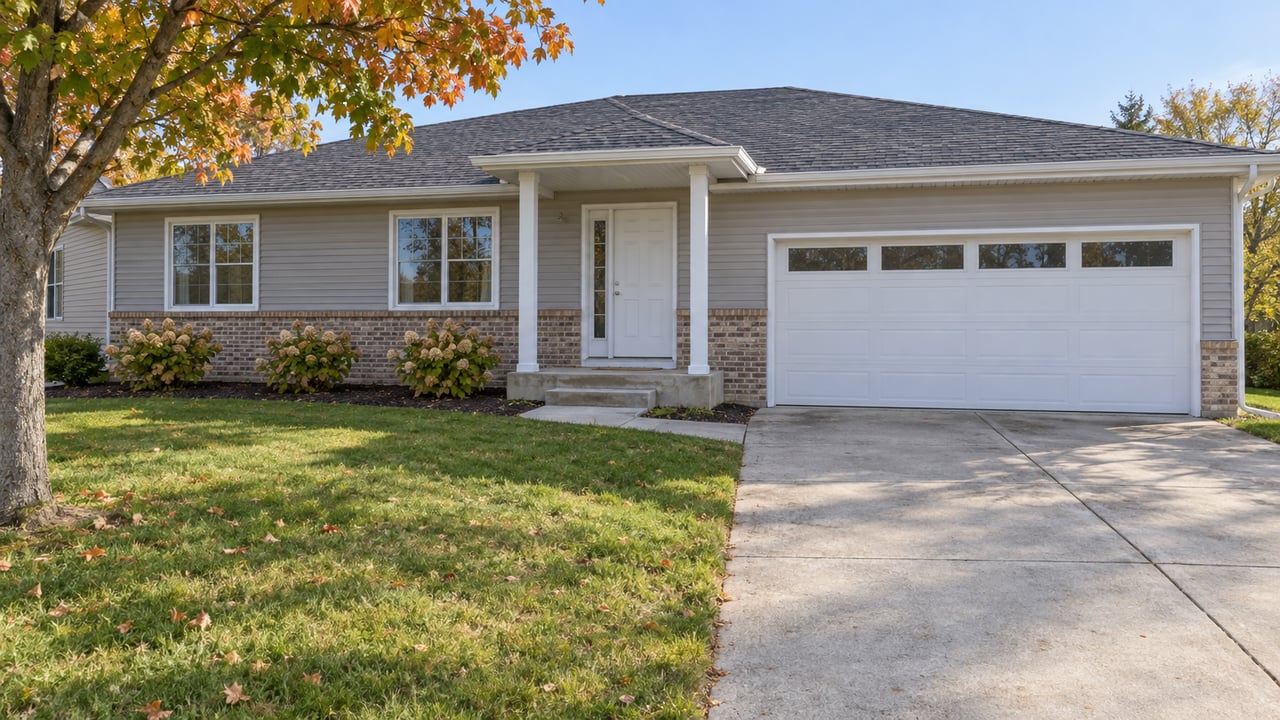
How would you define a starter home if you had to write it into state law? Wisconsin's answer is all measurements. For homes served by public improvements in these districts, the law caps single-family lots at under 7,500 square feet and one-story homes at 1,500 square feet. It says nothing about what the house sells for or who can afford it.
The law took effect October 1, 2026. Tomah has already told developers it plans to use it. If you're comparing Tomah or the rest of Monroe County with La Crosse County, this matters more than the month's median price. It could shape the look of some new homes in Tomah and the public financing available to support them.
The state drew the house first
The law is 2025 Wisconsin Act 235, which passed as Senate Bill 480. It was enacted April 8, 2026, and took effect October 1, 2026. It creates a new kind of tax incremental district. A city may use it only for single-family or two-family homes, and every one of them has to be owner-occupied.
Every public improvement in one of these districts has to serve homes that fit this spec:
| Requirement | Single-family home | Two-family home |
|---|---|---|
| Lot size | Less than 7,500 sq ft | 12,500 sq ft or less |
| Lot width | 70 feet or less | 80 feet or less |
| Side setback | No more than 10 feet | No more than 10 feet |
| Home size, one story | Up to 1,500 sq ft | Up to 1,500 sq ft |
| Home size, two stories | Up to 2,000 sq ft | Up to 2,000 sq ft |
A lot just under 7,500 square feet is about a sixth of an acre. In practice, that means a narrow lot with homes close together and a modest footprint. In a region where buyers often look for a yard and an attached two- or three-car garage, the state has picked a very different template to subsidize.
What the money is allowed to pay for
The financing rules decide who carries the risk of building to that spec. A residential district can pay only for infrastructure the homes need, such as streets and utilities, plus financing, professional services, and administrative and organizational costs. Stormwater work counts only when it serves the whole district, not individual lots. The money has to come from the district's own new tax increment or from developer financing. The Daily Reporter's October 16 commentary highlighted the same two features, infrastructure-only costs and developer pay-as-you-go financing, as the core of the new tool.
The law sets no sales-price cap and no household-income limit. The state is betting that a small house on a small lot will price itself.
The city also has to set, in advance, the maximum development fees it will charge in the district and the architectural and construction standards that apply there.
Why Tomah is moving early
Tomah has a specific gap to close. The city's 2022 Housing Study found that only 25 percent of the people who work in Tomah live in the city, compared with more than half countywide. The same study estimated Tomah needs 400 to 700 more housing units by 2030. The city lists Mars Petcare, USEMCO, Toro, Cardinal Glass and Walmart among the employers there, and says Fort McCoy has advised nearby communities to prepare for continued growth.
"We have the jobs. What we do not have is enough places to live," Mayor Paul Dwyer said in the city's news release on its fall development tour.
That tour ran September 30. It brought 36 developers, builders, lenders and real estate professionals to see 11 sites. The Greater Tomah Area Chamber of Commerce co-organized it, WHEDA was the state sponsor, and Tomah Health hosted the morning program, where CEO Derek Daly gave the keynote. Developers heard about Act 235 that day. They also heard that the city is rewriting its zoning code to make modular and manufactured homes easier to build, with completion expected early next year.
Put those two tools together and a pattern shows up. Small lots, small footprints and factory-built homes all point toward more modestly sized, owner-occupied homes in a city whose study found far more jobs than housing.
The two city-owned parcels already out for bid
Act 235 isn't attached to a specific site yet, and the city hasn't adopted a residential district. Two pieces of city-owned land are already in play, though:
- Jefferson Street. About 4 acres north of Jefferson Street near Schneider Avenue, offered for a two-family or small multifamily project. The RFP doesn't set a unit count.
- Brownell Street. About 5 acres north of Brownell Street near King Avenue, offered for multifamily housing with some affordable units, and possibly smaller-scale housing on part of the site. The parcel sits outside any TIF district. The city has said it would consider adding it to an existing district later in 2026.
Both RFPs went out September 1, and proposals were due October 15. The Jefferson schedule set interviews for October 17 and council evaluation for October 19, with construction starting in spring 2027. The city labels that timeline tentative. A September city administrator update said the two RFPs reached about 250 developers. It also said any housing-related boundary change to TID 8 would be timed around when a development agreement is ready and the required notices go out.
Neither parcel is a single-family subdivision. A residential district built to the Act 235 spec would be a separate step, and the city hasn't drawn one yet.
The ceiling written into the law
Act 235 also limits how much of this housing a city can finance at once. When a city creates a residential district, the new district's taxable value plus the value growth inside all its existing residential districts can't exceed 3 percent of the city's total equalized value.
The Wisconsin Department of Revenue certified Tomah's equalized value at $1,150,464,200 as of January 1, 2026. Three percent of that is about $34.5 million.
Once homes go up and that district's value grows, the growth counts against the 3 percent whenever the city wants to create another residential district. Monroe County's year-to-date median sale price through August 2026 was $261,500. At that price, $34.5 million is roughly 130 homes' worth of value. That's a rough calculation, since equalized value and sale price are different measures. The scale still holds. The tool can help start a neighborhood, but the city's own study counts a gap of 400 to 700 units, and the law alone won't close it.
Where the resale market sits today
All of this future supply lands on a resale market that is already moving in a different direction from La Crosse County. Here are the Wisconsin REALTORS Association's August 2026 county figures, the latest monthly report available:
| August 2026 | Monroe County | La Crosse County |
|---|---|---|
| Median sale price | $270,000, down 10.9% from Aug. 2025 | $330,000, up 6.3% |
| Sales | 49, down 12.5% | 129, down 3.0% |
| Months of inventory | 4.8, down from 7.0 | 3.7, up from 3.3 |
| Avg. days on market | 74, down from 84 | 70, up from 57 |
| Year-to-date median through August | $261,500, down 4.9% | $330,000, up 4.8% |
| Year-to-date sales through August | 311, up 5.1% | 932, up 5.5% |
In Monroe County, the median price fell while inventory got tighter and homes sold faster. A month with 49 sales is a small sample, so a few lower-priced closings can pull the median down. The year-to-date figures are steadier. Sales are up and the median is modestly lower, which suggests more modestly priced homes are changing hands. The roughly $70,000 gap between the two counties' year-to-date medians is the main reason people compare Tomah and La Crosse at all.
What this means for someone comparing Tomah
If the new homes Tomah attracts use Act 235, they'll fit the law's spec. That means owner-occupied single-family or two-family homes, narrow lots and modest square footage. Expect to see the difference in how new and existing homes are priced side by side in the coming years.
Sparta, the county's other main city, is adding supply a different way. The Residences at Timber Hills, by developer Todd Page at the north end of Alpine Drive, received final plat approval from the Sparta Common Council on June 10, 2026. As part of the project, 31 lots were rezoned from single-family to two-family, which allows condo-style or zero-lot-line homes. Within one county, then, there are two approaches: a subdivision approved under ordinary zoning in Sparta, and a city in Tomah preparing to use a state-defined starter-home district.
A few direct questions
Does Act 235 cap what a new home in Tomah can sell for? No. The law sets lot, setback and home-size limits and requires owner occupancy. It has no sales-price cap or income limit.
Has Tomah created a residential TIF district yet? The city has said it intends to use the law. Its public materials don't yet show an adopted residential district, boundary or project plan.
This post is general information, not legal, tax or financial advice. Please confirm how any law applies to your situation with the right professional.
If you're weighing a Tomah home against one in La Crosse County, or wondering how new small-lot construction could affect the value of a home you already own in Monroe County, Favre & Co. follows these developments site by site. Start with a straight answer to "What's My Home Worth?" and we'll put your property in context with what's coming next.